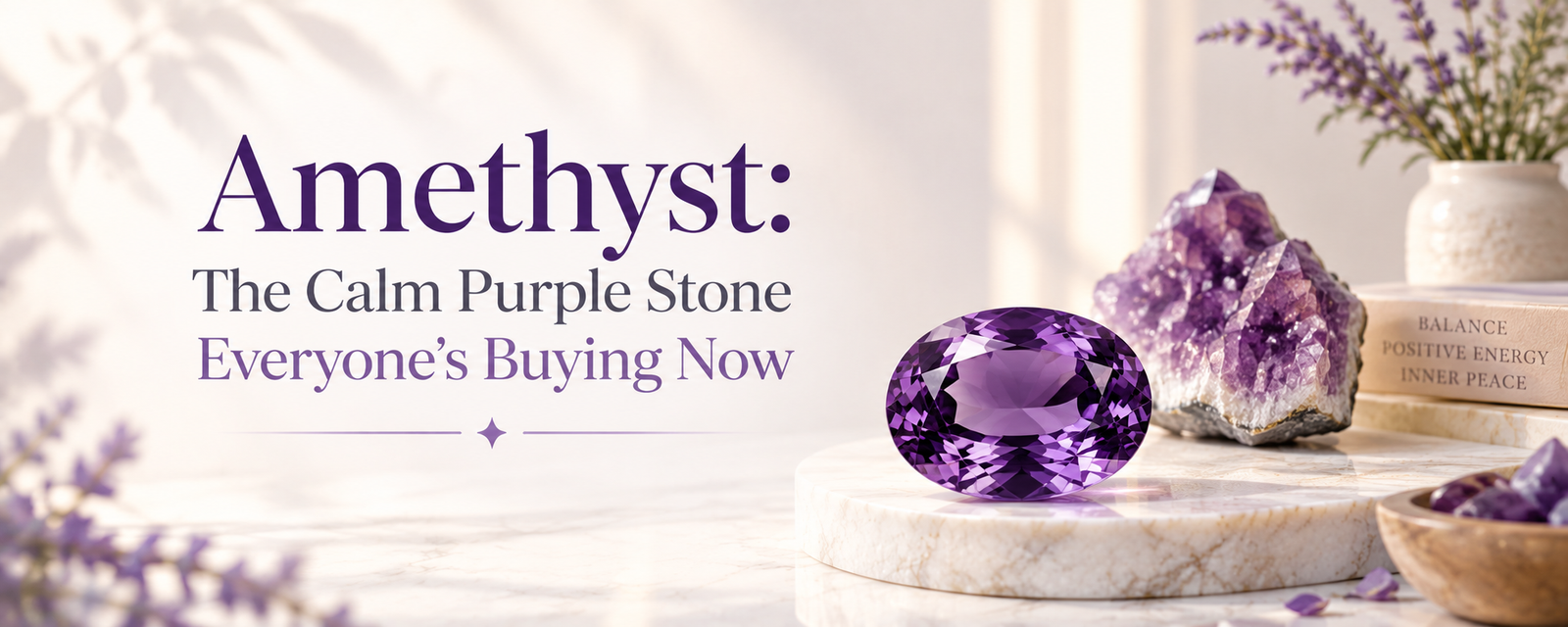
If you've noticed more people wearing a soft purple stone lately — on a ring, a mala, sometimes just a loose piece kept on the study table — that's probably Amethyst. And no, it's not just a passing trend. There's real data behind it, and there's a genuine reason astrologers have been recommending it more often over the last couple of years.
We sell Amethyst regularly at our Rohini showroom, and honestly, it's become one of our more interesting conversations with customers — because half the people buying it want it for astrology, and the other half just want it because it looks calm and elegant. Both reasons are valid, and we'll walk you through what actually matters either way.
What Amethyst Actually Is
Amethyst — called Jamunia or Kathela in Hindi — is a purple variety of quartz. Its colour comes from trace iron and natural irradiation within the crystal structure, and it ranges from a pale lilac to a deep, almost wine-like violet. The deeper and more evenly saturated the colour, generally, the higher the value.
Unlike Ruby or Sapphire, which belong to the corundum family, quartz-based stones like Amethyst are more abundant in nature. That's actually good news for buyers — it means genuine, natural Amethyst is far more accessible in price than something like Neelam or Panna, without compromising much on beauty.
Why Astrologers Recommend It
In Vedic tradition, Amethyst is often used as an alternative gemstone for Saturn (Shani) and, in some schools of thought, for Ketu — particularly for people whose main chart stones (like Blue Sapphire) come with higher risk if the match isn't exact. Amethyst is considered gentler, which makes it a reasonable starting point for someone who's nervous about wearing a stronger, faster-acting Rashi Ratna.
That said — and we say this to every customer who walks in — "gentler" doesn't mean "guaranteed." No gemstone works the same way for two different charts. If you're buying Amethyst specifically for astrological reasons rather than just as jewellery, it's worth getting your Kundli checked first, even for a milder stone like this one.
Where the Market Actually Stands Right Now
Here's something worth knowing before you buy. Industry research on the global gemstone market shows semi-precious stones — Amethyst, Topaz, Garnet, and Aquamarine among them — growing faster than precious stones right now, largely because of rising demand for affordable, everyday jewellery among younger buyers who want originality without the price tag of a Ruby or Emerald.
In India specifically, the broader gemstone market was valued at roughly USD 2.18 billion in 2025 and is projected to grow steadily through 2034, with certification and traceability becoming a bigger buying factor every year — meaning more Indian buyers are actively asking for lab reports before they purchase, not just trusting a shopkeeper's word. That shift benefits you directly as a buyer, because it's pushed more sellers, including us, to certify everyday stones like Amethyst that used to be sold without much documentation at all.
What Amethyst Actually Costs
Since it's a quartz-family stone, Amethyst is priced very differently from corundum or beryl gemstones. Here's a realistic breakdown:
| Grade | Description | Typical Price (per carat) |
|---|---|---|
| Commercial grade | Pale colour, visible inclusions | ?50 – ?150 |
| Good grade | Even medium-purple colour, minor inclusions | ?150 – ?400 |
| Fine grade | Deep, saturated purple, eye-clean | ?400 – ?800 |
| Rare/exceptional | Exceptional "Deep Siberian" colour, high clarity, larger sizes | ?800 – ?1,500+ |
Compare that to Neelam or Panna, which routinely run into tens of thousands of rupees per carat, and you'll see why Amethyst has become a popular entry point for people who want a genuine, certified gemstone without a heavy price tag.
How to Make Sure You're Buying the Real Thing
Because Amethyst is inexpensive relative to precious stones, a lot of buyers assume there's no real risk of being cheated. That's actually not true. The market does have:
- Synthetic (lab-grown) amethyst — chemically identical to natural stone but grown in a lab, sold at a fraction of the price without disclosure in some shops.
- Dyed or glass imitations — cheap glass tinted purple, especially common in loose bead and bracelet markets.
- Heat-treated amethyst sold as "natural" — heating can shift colour (sometimes even toward citrine), and this should be disclosed on the certificate.
A proper lab certificate will confirm natural origin and disclose any treatment. We keep our full certified Amethyst (Jamunia) collection listed with lab reports for exactly this reason — so you're not relying on trust alone.
Amethyst vs. Other Saturn-Related Stones
If you're weighing Amethyst against other stones astrologers commonly suggest for Saturn-related concerns, it helps to see them side by side:
| Stone | Intensity | Typical Price Range | Best For |
|---|---|---|---|
| Amethyst (Jamunia) | Mild | ?50 – ?1,500/carat | First-time wearers, budget-conscious buyers |
| Blue Topaz (Neela Pukhraj) | Moderate | ?1,000 – ?4,000/carat | Slightly stronger effect than Amethyst, still low-risk |
| Blue Sapphire (Neelam) | Strong, fast-acting | ?15,000 – ?1,00,000+/carat | Confirmed strong Saturn placement, after proper consultation |
If you're unsure which of these actually fits your chart, our free horoscope-based gemstone consultation covers exactly this comparison for your specific Kundli, at no cost if you visit our Rohini office.
The Takeaway
Amethyst is genuinely one of the more forgiving, affordable gemstones you can start with — good for daily wear, reasonably priced, and low-risk astrologically compared to its stronger cousins. But "affordable" doesn't mean "unregulated" — synthetic and dyed imitations are common enough that a certificate still matters, even on a ?500 stone. If you're in Rohini, Pitampura, or anywhere in Delhi NCR, come see the difference between a certified stone and an uncertified one for yourself; you'll notice it in the colour under proper light within a minute.
Have you worn Amethyst before, for astrology or just for the look of it? What was your experience — did it feel different, or was it purely aesthetic for you? Tell us in the comments.